
A slow website can affect customer experience, engagement and business conversions. When visitors have to wait too long for a page to load, they may leave before exploring your products or services.
Website speed optimization is the process of improving website performance so that pages load efficiently across desktop and mobile devices.
For businesses that depend on online enquiries, sales and organic traffic, website performance is an important part of a successful digital strategy.
Whether you operate a business website, WordPress platform or eCommerce store, optimizing loading speed can help create a smoother browsing experience.
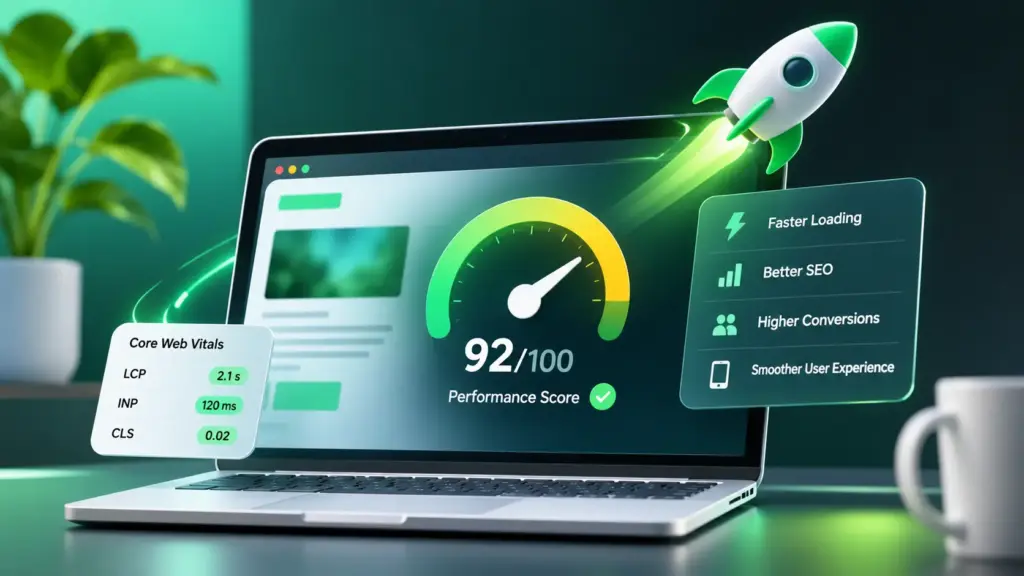
Website speed optimization involves improving the technical performance of a website to reduce loading delays and make interactions smoother.
It includes optimizing images, scripts, server responses, caching, website code and other performance-related elements.
Important areas of website speed optimization include:
Image compression and optimization.
Browser and server-side caching.
CSS and JavaScript optimization.
Database optimization.
Content Delivery Network (CDN) configuration.
Mobile performance optimization.
Server response time improvement.
Core Web Vitals optimization.
Website performance influences how visitors interact with your business online.
A faster website can provide several advantages:
1. Better User Experience: Visitors can browse pages and access information more comfortably.
2. Improved Mobile Experience: Optimized websites perform more efficiently on smartphones and tablets.
3. Better Conversion Opportunities: A smoother browsing experience can reduce friction during enquiries, purchases and registrations.
4. SEO Performance: Page experience and Core Web Vitals are among Google’s ranking considerations, although speed alone does not guarantee higher rankings.
5. Better Website Engagement: Visitors can navigate content and explore services without unnecessary delays.
Core Web Vitals are Google’s user experience metrics used to evaluate important aspects of website performance.
The three main metrics are:
LCP measures how quickly the largest visible content element loads.
Good target: 2.5 seconds or less.
INP measures how quickly a website responds to user interactions throughout a visit.
Good target: 200 milliseconds or less.
CLS measures unexpected visual layout movement while a page loads.
Good target: 0.1 or less.
Meeting these recommended thresholds can help provide a better user experience.
Large image files can significantly affect page loading performance.
Use appropriately sized images, modern formats such as WebP or AVIF and compression without unnecessary quality loss.
Caching stores certain website resources so returning visitors do not need to download everything again.
Browser caching and suitable page caching can improve loading efficiency.
Remove unnecessary spaces, comments and redundant code from CSS and JavaScript files to reduce file sizes.
Excessive or poorly optimized WordPress plugins can affect website performance.
Review installed plugins and remove unnecessary functionality.
Website hosting affects server response time and overall performance.
Choose a hosting environment suitable for your website traffic, platform and technical requirements.
Lazy loading delays the loading of certain images and other resources until they are needed.
This can reduce initial page loading work, especially on image-heavy websites.
Use efficient font formats, reduce unnecessary font weights and avoid loading font files that are not required.
A CDN distributes website resources through geographically distributed servers, helping visitors retrieve content from locations closer to them.
Analytics tools, advertising scripts, chat widgets and external integrations can add loading and processing overhead.
Load only the scripts your business actually needs.
Use tools such as Google PageSpeed Insights, Lighthouse and Search Console to identify performance issues and track improvements.
Businesses can use several tools to measure website performance.
Google PageSpeed Insights: Measures performance on mobile and desktop and provides optimization recommendations.
Google Lighthouse: Audits performance, accessibility, SEO and other website quality factors.
Google Search Console: Provides Core Web Vitals reporting based on real-world user experience data when sufficient data is available.
GTmetrix: Helps analyse loading performance, page structure and resource-related issues.
Testing both mobile and desktop versions is important because performance can vary between devices.
WordPress powers a wide range of business websites, blogs and eCommerce platforms.
However, themes, plugins, large images and hosting configurations can influence its performance.
Effective WordPress speed optimization may include:
Selecting a lightweight theme.
Optimizing Elementor and other page builder assets.
Removing unused plugins.
Configuring caching.
Optimizing the WordPress database.
Compressing images.
Reducing unnecessary scripts.
Updating WordPress and its components.
The goal is to improve performance without breaking website functionality or design.
Avoid these common mistakes when improving website performance:
Compressing images without checking visual quality.
Installing multiple overlapping optimization plugins.
Delaying essential JavaScript without testing functionality.
Using excessive animations.
Ignoring mobile performance.
Choosing hosting without considering website requirements.
Optimizing desktop performance while neglecting mobile users.
Focusing only on a PageSpeed score instead of actual user experience.
A successful optimization strategy should improve real performance while maintaining website usability.
Appsfruit helps businesses strengthen their digital presence through website development, digital marketing and search optimization strategies.
A well-performing website should combine visual quality, technical reliability, responsive design and a smooth user experience.
Our digital solutions focus on helping businesses develop and improve their online platforms through:
Website Design and Development.
WordPress Website Development.
Website Performance Optimization.
Technical SEO.
Mobile-Friendly Website Development.
eCommerce Website Development.
Search Engine Optimization (SEO).
Answer Engine Optimization (AEO).
Generative Engine Optimization (GEO).
Whether you are launching a new business website or improving an existing platform, performance should be considered an important part of your digital strategy.
Website speed is an important part of building a successful digital experience. A visually attractive website should also load efficiently, respond smoothly and work consistently across different devices.
By combining technical optimization, responsive development and Core Web Vitals improvements, businesses can create websites that are better equipped to serve their customers.
At Appsfruit, we believe a great website should not only look professional but also deliver a smooth, reliable and performance-focused digital experience.
Explore Appsfruit’s digital solutions at https://appsfruit.com/ and take the next step towards a better-performing website.